21 million screws sunk
SCHULZ wheel-bolt systems for the automotive industry
Most drivers only think about the bolts that keep our wheels on the car at most twice a year. We at SCHULZ’s mechanisation team for the automotive industry deal with a wide range of wheel-bolt topics every day.
Our goal is to provide customer-specific automation solutions. Our latest project, built for a well-known automobile manufacturer in Bremen, tightens five million wheel bolts per year. The system precisely monitors parameters such as angle of rotation and tightening torque, enabling us to document electronic quality assurance for wheel assembly.
We have been involved in mounting wheels on vehicles for decades. The first systems were still networked with Interbus-S; today, intelligent sensors report back via IO-Link and PROFINET captures the entire sensor set. But we have developed as well: whereas we used to be responsible as a partner for control engineering, today we deliver turnkey systems for the entire process.
Here, we benefit from the expertise of the various departments within the SCHULZ Group. We have our own design engineers, including in mechanical engineering, and we operate systems such as Siemens NX and CATIA in-house. Our own crane construction department not only assembles crane systems, but is also able to design, manufacture and install complex rail systems worldwide.
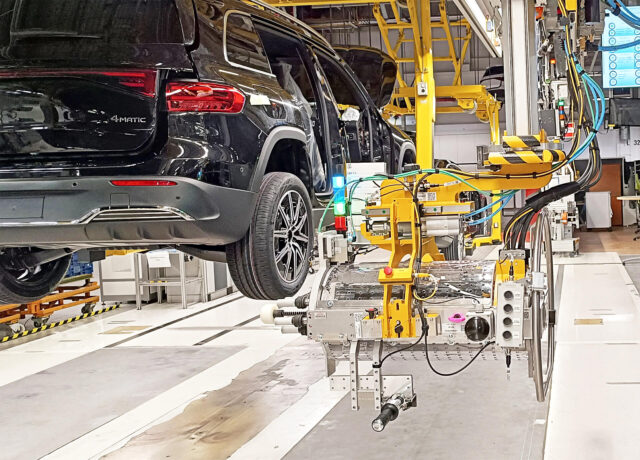
The system installed at the beginning of 2025 is the fourth in a series of ceiling-suspended wheel-bolt systems—an entirely new design developed in-house. The major advantage of this design is that the floor, and thus the walking area, remains completely free of any system technology. This means the operator can move around freely, cleaning is straightforward, and maintenance staff do not have to walk over a machine bed. However, the ceiling-guided system involves greater design effort, because very different forces act on the system. For the bolt drum – the heart of the system – this is already the fourth iteration, and we have reached a broadly accepted level of maturity. The drum has a modular design, which offers the advantage of faster repairs during maintenance. This means a bolt drive can be replaced in just a few simple steps—a real advantage for smooth operation, as it significantly reduces downtime and production stoppages. It also benefits us, because the modular concept allows us to respond to customer requirements with minimal effort. Not every vehicle has five wheel studs, to name just one example from the range of possible modifications.
With the bolt drum – also called the bolt manipulator – the fully automated tightening process begins. It is ergonomic, height-adjustable and moves in sync with the car body during tightening.
In this system, we implemented a ceiling-guided wheel fitting trolley for the first time. It takes complete wheels from the incoming conveyor technology and supports the operator when positioning the wheel. With pneumatic assistance in all three axes, the wheel can be placed onto the hub with minimal physical effort, and the wheel bolts can be pre-fitted manually. After the wheel is positioned and the operator has given approval, the wheel fitting trolley returns fully automatically to the transfer position, locks in place there and is ready to take the next wheel. In the meantime, the employee positions the bolt drum on the pre-fitted wheel and starts the automatic tightening process. This is also pneumatically assisted and runs in sync with the line, moving together with the car body.
Here too, after completion of the all-electric tightening operation, the controller returns the system so the operator doesn’t have to do anything else. In the event of a faulty tightening, it goes without saying in the era of Industry 4.0 that messages are generated and displayed both on the large 43-inch display and on employees’ smartphones. Installation during the year-end shutdown also went smoothly because we first tested the assembly cells in a complete pre-assembly at our Bremen site under trial operation. This also included running a moving car body on a guided dummy conveyor system alongside the system.
Our project manager Tim Wiegers describes the benefits: “A test setup like this gives us the opportunity to carry out pre-commissioning under absolutely realistic conditions. Thanks to the teamwork with our client, this worked extremely well here too, because a real car body was provided to us.” The control software also went through digital simulation and commissioning in advance. This minimised the effort required for pre-commissioning on the one hand, and on the other helped us with topics we couldn’t reproduce in our hall. That way we can always be sure: in the end, a system that has been thoroughly tested from top to bottom sets off on its journey—regardless of which continent and which production environment it will later be installed in. Quality “Made by SCHULZ” is included.
After the test run, the conversion took place in the real production environment—in an area with the highest cycle rate. Following minor complications during the dismantling of the old system, we were able to make up the time again thanks to the know-how gained from the test setup. Production ramp-up in the new year started on schedule. This brings the systems we are currently implementing to an annual tightening output of around 21 million wheel bolts. Our thanks go to the entire team and everyone involved who made this achievement possible.
Our wheel-bolt system is the result of decades of experience, teamwork and technological precision – from the first test run to turnkey handover. If you tighten with us, you tighten with a system.
Robert Straub, Head of Automotive Automation Department, SCHULZ Systemtechnik