Grid stability for north-west Germany
Energy storage parks in Leer
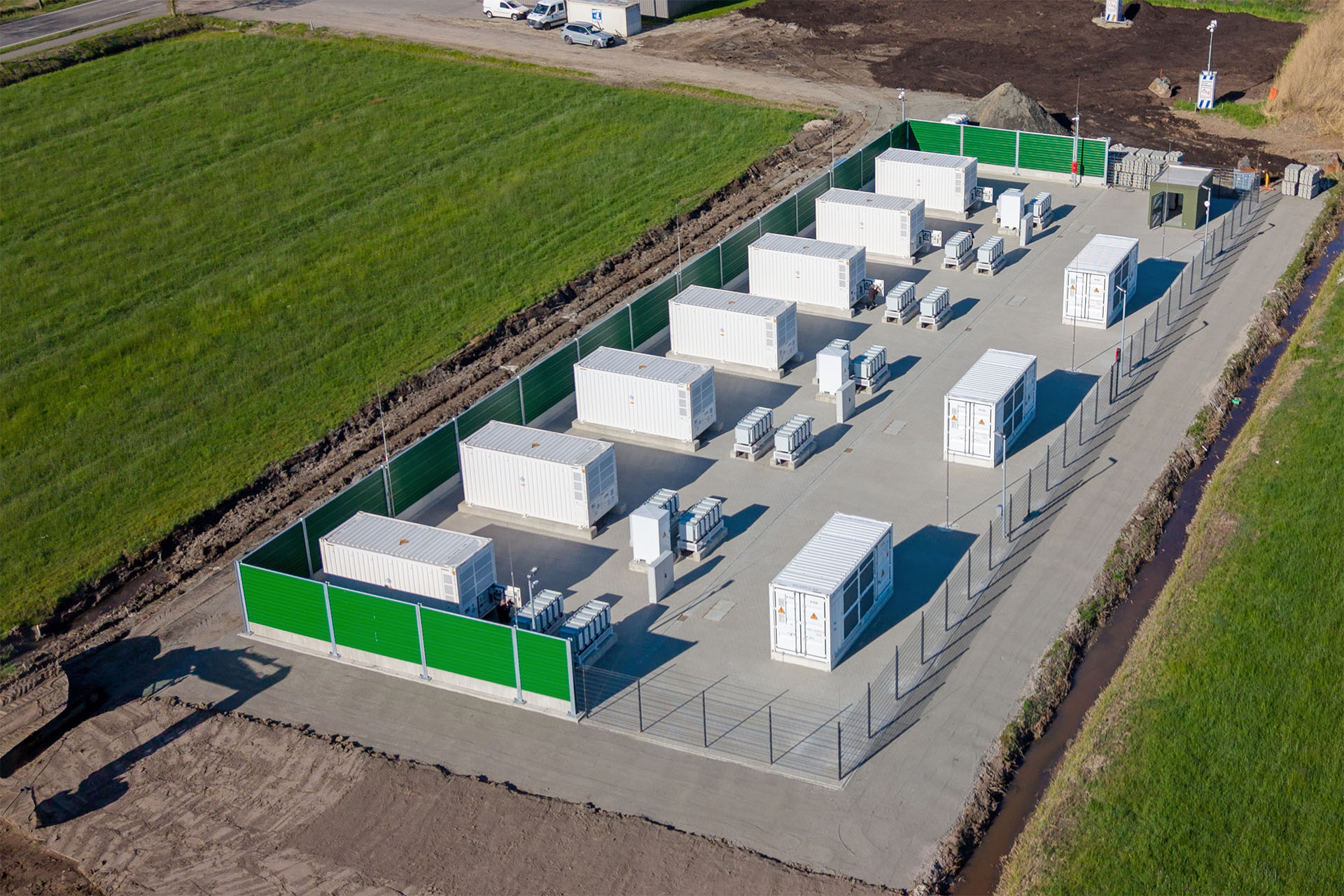
The expansion of infrastructure for storing renewable energy continues to accelerate. As specialists in complete battery energy storage solutions, we support our clients with a fully integrated approach throughout every stage of a project. In Leer, East Frisia, we delivered two energy storage projects: Leer I with an output of 15 MW and a storage capacity of 31 MWh, and Leer II with 4 MW and 9 MWh. Together, the two facilities contribute a combined output of 19 MW and a storage capacity of 40 MWh, helping to stabilise the electricity grid across north-west Germany.
The project site presented our team with an unexpected challenge. Located on peatland, the ground conditions were far from ideal for installing infrastructure weighing several tonnes. “We needed a high-performance piling rig to drive timber piles of up to eleven metres in length into the ground,” explains Damian Wertulla, product manager for battery energy storage systems at SCHULZ. In total, more than 200 piles were installed and approximately 4,800 tonnes of soil were replaced to create a stable foundation for the facility.
What began as an undeveloped greenfield site evolved into a highly complex infrastructure project. The scope ranged from the grid connection point at the substation and approximately 800 metres of cable route through to the complete construction of the energy storage park, including all transformer stations and battery systems. The primary objective is to balance fluctuations within the electricity grid. Sebastian Wigger, team leader for energy technology and building automation, explains: “The battery energy storage park reliably maintains the balance between electricity generation and consumption, helping to ensure a stable and resilient grid.”
Successful delivery of the project required a high level of coordination. The various disciplines involved – including civil engineering, energy technology and network infrastructure – had to be carefully planned and executed in close alignment. This is where our teams demonstrated the collaborative strength that defines SCHULZ. Together, they developed an intelligently integrated solution and delivered another important building block for the energy transition.
2
19 MW
9
800 m
200
4.800 t
all
Energy storage projects: Leer I & Leer II
Total output | 40 MWh capacity
Battery storage
Grid connection to the Nüttermoor substation
Driven timber piles (up to 11 m in length)
Soil replacement
EPC services delivered: civil engineering works, foundations, drainage concept, noise barrier wall, perimeter fencing, lightning protection, fire protection, control and protection systems as well as certification of the complete system.
“Energy storage systems are a key enabler of the energy transition. Projects such as those in Leer create the infrastructure required for a stable and future-ready electricity grid.”
Sebastian Wigger, Team leader for energy technology, SCHULZ Visbek