Production system for hybrid components in electric vehicle manufacturing
Automation solution for outsert technology
In modern electric drivetrains, highly complex components are responsible for battery management and power distribution. These often consist of delicate individual parts whose assembly in high-volume production requires exceptional precision. Outsert moulding offers a practical solution by transforming these components into hybrid parts.
TB&C GmbH (a Delta Group company) specialises in exactly this type of component. Using outsert technology, metal structures are overmoulded with plastic to create functional hybrid components. These parts are easier and faster to install, offer a high level of functional integration, reduce weight and help lower manufacturing costs. As a supplier to the automotive industry, TB&C provides these components to manufacturers including BMW for the production of its latest electric vehicle models.
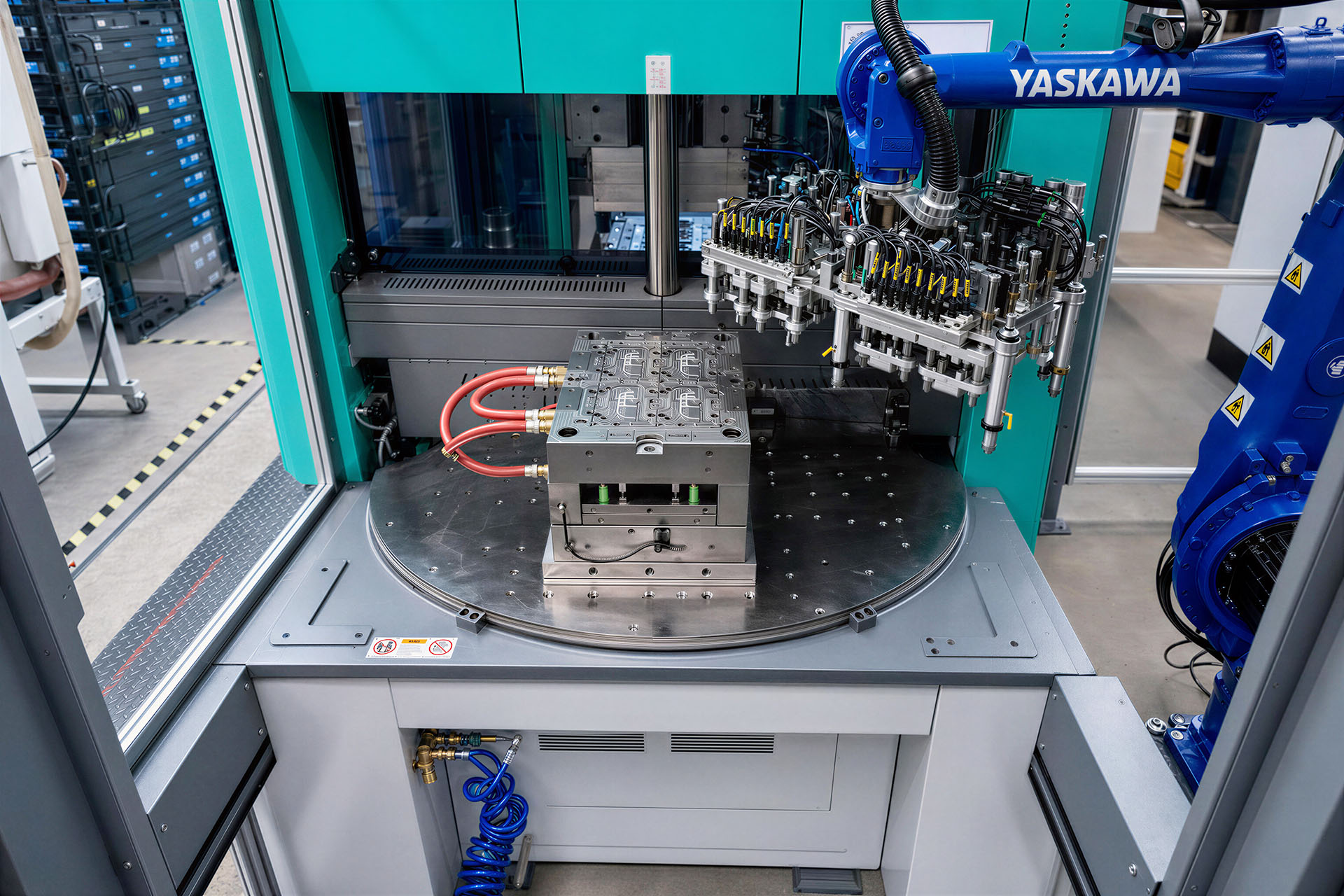
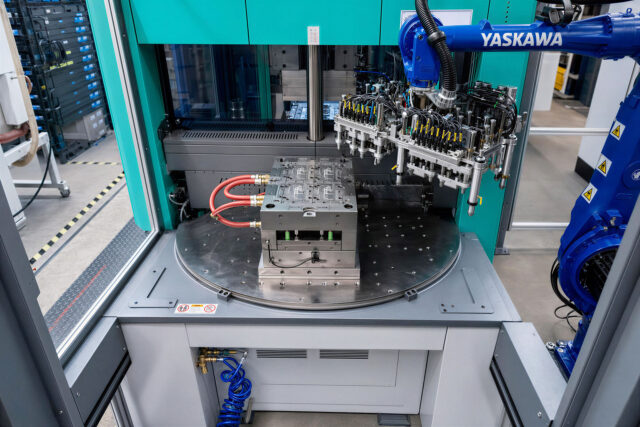
Outsert moulding – automated tool loading in a rotary-table injection moulding cell by a six-axis robot. High-precision gripping technology ensures accurate positioning of inserts, reliable part removal and synchronised processes within a single production cycle.
To make the assembly of these hybrid components even more efficient, TB&C commissioned our special-purpose machinery team to develop a dedicated automation solution. The objective was to create a highly automated production system for outsert moulding that intelligently links multiple process steps.
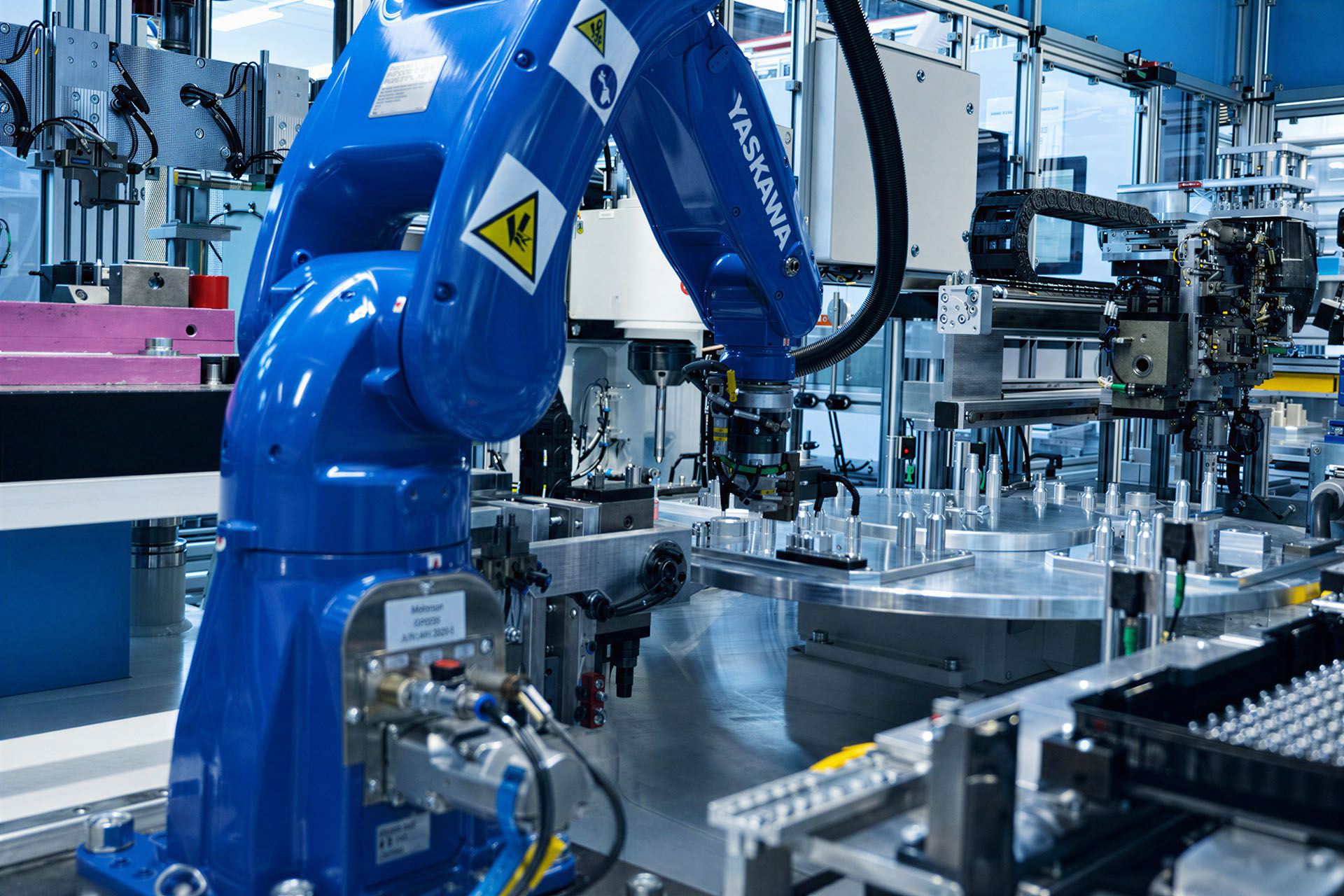
The system includes the automated feeding of coated copper busbars into the injection moulding machine, unloading of overmoulded components and subsequent manufacturing processes such as punching, bending, calibration and riveting. Camera-based quality inspection, high-voltage testing, DMC marking, cleaning and automated tray packaging are also fully integrated into the process.
Alongside an innovative technology for lifting and transporting multiple small components simultaneously, precise project planning was essential. To enable production to start as quickly as possible, the system was implemented in three development stages.
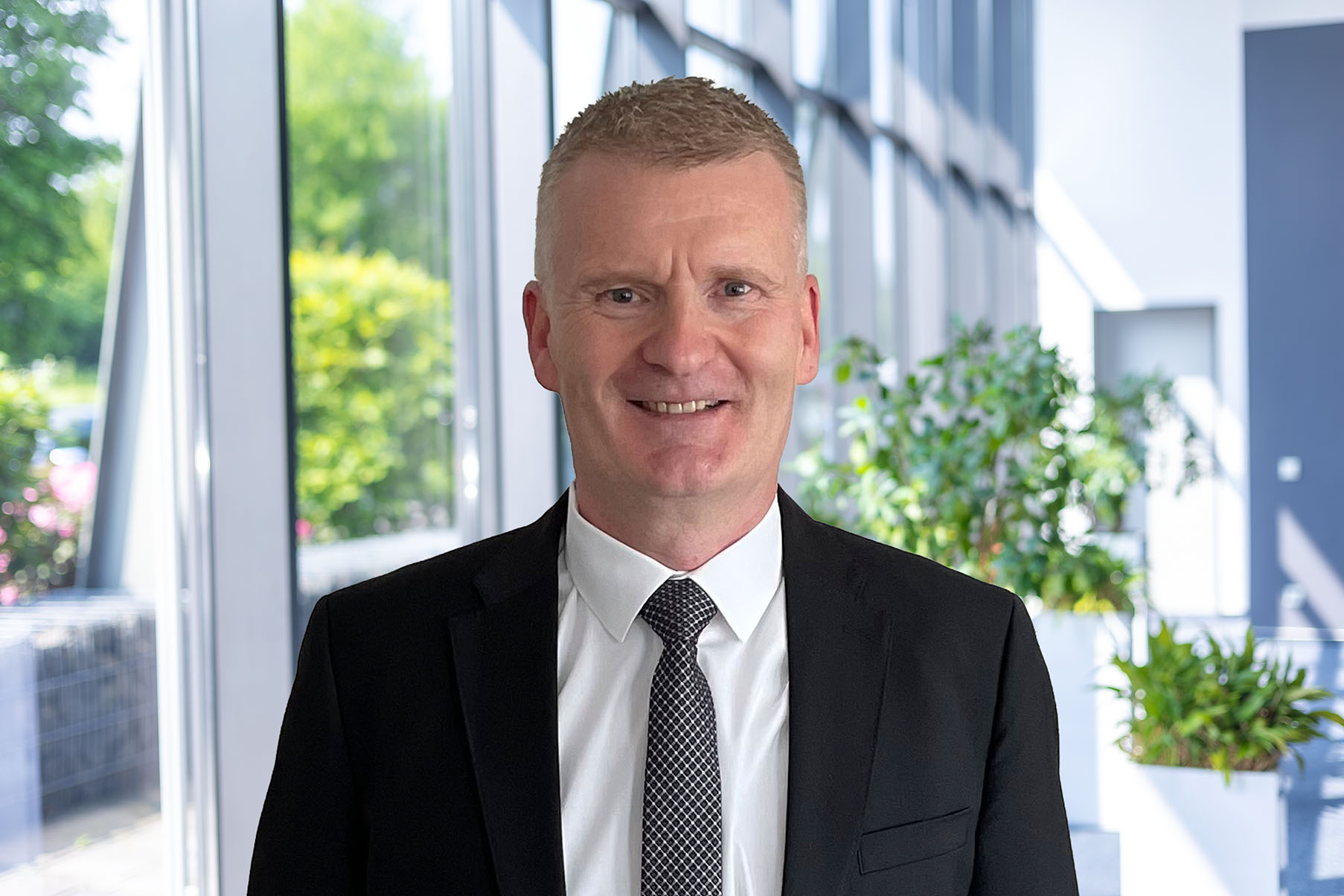
Bernd Mühl, sales manager for special-purpose machinery at SCHULZ, explains: “The production line had to be operational within a very short timeframe while still allowing room for additional process steps in the future. This modular approach was a key success factor both in the system design and in securing the project.”
TB&C particularly valued the collaborative partnership throughout the project: “The intelligently designed and highly practical automation solution delivered by the SCHULZ team, combined with an exceptionally fast implementation, impressed us from the outset. We look forward to continuing our partnership on this project and on many future initiatives,” says Daniel Stadelmann, process engineer and project manager at TB&C. “Particularly in complex manufacturing environments like this, it is essential to work with a reliable partner who understands the technology, production processes and the requirements of leading automotive manufacturers equally well.”
Für dieses Projekt sowie für zahlreiche weitere Vorhaben ist eine weiterhin partnerschaftliche Zusammenarbeit vorgesehen und erwünscht“, berichtet Daniel Stadelmann, Process Engineer und Projektverantwortlicher von TB&C. „Gerade bei solch komplexen Fertigungsprozessen ist ein zuverlässiger Partner wichtig, der Technik, Prozessabläufe und Anforderungen der Markenhersteller im Automotive-Bereich gleichermaßen versteht.“
With this solution, our special-purpose machinery team has once again demonstrated how intelligent automation can help drive the future of electric mobility.
Particularly in complex manufacturing environments like this, it is essential to work with a reliable partner who understands the technology, production processes and the requirements of leading automotive manufacturers equally well.
Daniel Stadelmann, Process Engineer TB&C GmbH